
There are countless examples in human history where a seemingly simple idea would ultimately become engrained in our everyday fabric.
The internet, your Apple/Mac products, fast food chains, those Adidas tennis shoes you wear, the lift you ride at your office location, and everything in between, were all once a mere concept rather than necessities.
Odoo’s origin story truly is no different. And in a field that has long been gripped by global tech conglomerates and software juggernauts, smaller companies often fight for the scraps that remain while aiming to carve-out their little corner as a beachhead to kickstart growth.
We forget that those same dominant entities in their respective fields sprouted from humbler beginnings. A parent’s garage, the company mailroom, and, in the case of Odoo, the classrooms and dormitories of a University.
As the leading open-source ERP platform in Europe, Odoo is an example of invention, ingenuity, and the requisite determination that is a key defining ingredient necessary to achieve greater success.
From a small passion project that has been molded over time into a product utilized globally by millions, diving into how Odoo got here is a story worth unraveling.
Pinckaers’ spark at Leuven
It should come as no surprise that the University of Leuven, one of Belgium’s flagship academic institutions, is the backdrop of Odoo’s origin story.
As a young computer science student among its budding student body, Fabien Pinckaers had motivations to go beyond software-centric curriculum learning. Instead, he envisioned something far more impactful.
With small and medium-sized enterprises (SMEs) lacking in flexible, affordable, and integrated software that were business-centric, and notable ERPs such as SAP and Oracle offering services that tailored to corporations while being far above the price-point for small business owners, an opportunity for Pinckaers presented itself.
That’s why, in 2005, he launched TinyERP: a lightweight resource planning software that was expressly designed around the ideals of simplicity. Early versions of the platform were basic, offering inventory, invoicing capabilities, and accounting.
But what helped TinyERP initially stand out was its modularity, where users could focus solely on what suited their needs. This would inevitably see SMEs pulled in its direction, thus paving the way for further scaling and development.
Scaling an idea: The birth of OpenERP
With the development and success of TinyERP came Pinckaers’ realization that, to fully tap into the product’s potential, further improvements and expansion became a necessity.
Three years after the initial launch of TinyERP, Pinckaers successfully rebranded the platform to OpenERP as a nod to its open-source roots and its potential to further evolve.
Like similar products in today’s market, OpenERP gained considerable traction among the developer community owing to its full source code that welcomed direct contributions. It was hardly surprising that businesses based not just in Europe, but various locations around the globe began implementation efforts on the back of the growing network.
Why did OpenERP ultimately stand out among the larger crowd? Simple; it’s modularity.
With businesses and developers alike afforded the ability to choose between a suite of applications ranging from HR, manufacturing, project management, and sales, as if you were ordering from an à la carte menu, OpenERP quickly distinguished itself among its contemporaries. The notion that users would not be tied to buying into a monolithic system was the icing on the cake.
Beyond ERP: Odoo becomes a reality
By 2014, less than a decade after TinyERP was introduced, Pinckaers’ company achieved an impressive amount of growth, perhaps beyond expectations, but was still presented with challenges as the landscape continued to shift.
For all its success, perceptions surrounding OpenERP limited how it was viewed in its operating space. Despite core software having grown into a platform suite fully capable of business management on a greater operational level, including avenues such as marketing and e-commerce, to project planning and CRM, a second rebrand was pending.
Pinckaers once again would edit the script to what we now know as Odoo, with its abstract name honoring the ongoing flexibility and ever-changing nature of the platform as horizons continued to be explored.
With the second rebranding came further evolution on the strategic front. ERP remained the beating heart, but Odoo would ultimately reposition itself as an all-in-one business solution that would no longer simply hone in on operations and/or finance software, but rather, become a toolbox that could be relied on across a broader spectrum.
Open-Source meets SaaS
As any business comes to grips with challenges, one of the key decisions faced is correctly navigating profit maximization while ensuring key philosophies stand the test of time. In the case of Odoo, it would be how open-source can remain a central component.
Given those considerations, the solution that would ultimately present itself would come in the form of a dual licensing model: Odoo Community and Odoo Enterprise.
With Odoo Community, open-source access with core modules would be free. As for Odoo Enterprise, the same open-source and core modules would be included, along with advanced features along with hosting and support capabilities, all in a paid package.
As continued commercial growth for the company had then been secured, Odoo Community allowed the continued participation of the global developer users that had become such an integral piece of the puzzle.
Moving forward, Odoo Online - it's Software as a Service (Saas) component - was later introduced. This was a hosted version that successfully eliminated the need for technical setup while simultaneously broadening its appeal to users who lacked a technical background. Additionally, small business owners who were on the hunt for a platform based around simplicity and ease of use could feel far more confident with implementation efforts.
Despite hitting achievable aims and popularity, criticism was not lacking. Odoo was deemed by some to have hidden popular features within a paywall structure that many were unwilling to negotiate, even if the new structure was necessary for financial self-sustainability and continued product development.
Odoo achieves global expansion
Headquartered in Grand-Rosière, Odoo has continued on to the next phase of the company’s expansion operations; growing its international footprint. As of today, it is the most installed business software globally.
Here is how some of the numbers break down:
15,000,000 Users Worldwide
Total Valuation as of Late 2024: €5 billion (per TechCrunch)
50
Main Apps
+1,500
Active Members
+50k
Contributed Apps
Key Office Locations
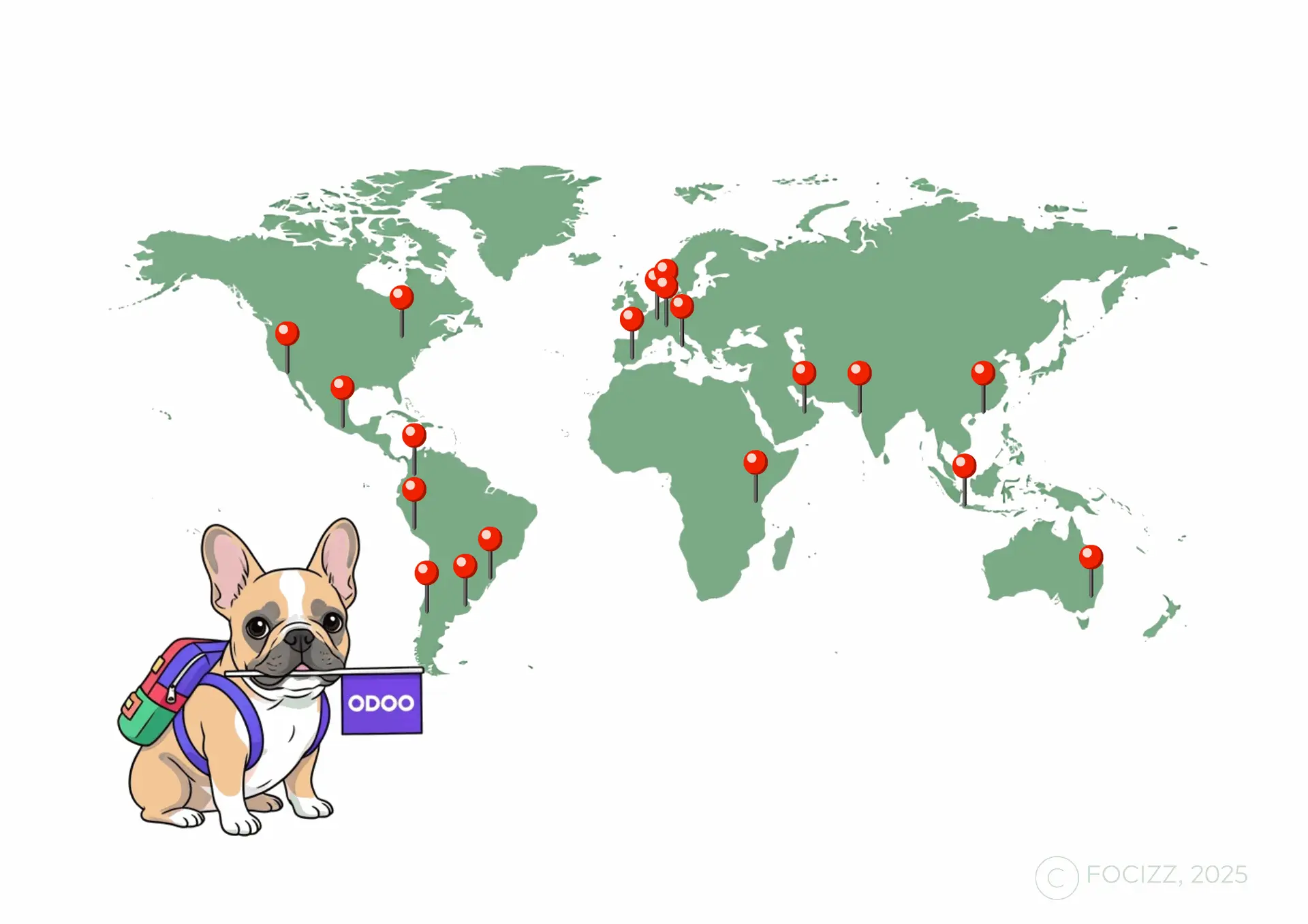
As an indication of not only its growth, but also its success, clients and partners that utilize Odoo are some of the biggest on the planet, and include car manufacturing giants Toyota and Hyundai, and French multinational food and beverage company Danone.
It stands to note that Odoo remains heavily embedded in the small and medium-sized business sectors as well, and continued faith at those operating levels persist as a source of pride and commitment to and for the company.
Furthermore, Odoo's list of accolades is proof-positive of not just their growth, but an impressive level of success. Dating back to 2010, Pinckaers and his company have been recognized on numerous occasions:
A legacy of accolaids
Tracking Odoo's growth and success
Why you should choose Odoo
Odoo's recognized global appeal speaks truth into their reliability, innovation, and client/user satisfaction.
Given it's presence in a space which is so often dominated by ERP systems that are both costly and operationally rigid, here are some key reasons why Odoo is the right choice.
Open-source foundations that offer transparency, control, and steady community innovation.
Modularity that affords businesses the ability to install apps they truly need.
Favorable price points that offer a lower total cost of access compared to legacy ERPs.
A vibrant and ever-growing ecosystem containing thousands of apps alongside an expansive partner network.
Suite integration covering all your needs, and an interface that remains user-friendly compared to its competitors.
Consistent UX improvements and mobile responsiveness.
Criticisms and roadblocks
Odoo has been a categorical success, but success does not dispel the inevitability of criticisms and roadblocks.
Tensions between its roots as an open-source tool and the necessity of monetization remain a steady challenge along its path. As mentioned earlier, criticism surrounding its paywall offered a significant point of frustration for users who were denied access to many exclusive features linked to Odoo Enterprise.
Finally, the sheer competitive nature of the market Odoo finds itself in is a considerable challenge in itself. Rivalries from other open-source platforms and the continued influence of tech giants such as SAP, Oracle, and Microsoft Dynamics meant that, for Odoo to remain not only relevant but popular, evolution must remain constant.
Like a circus act of old, walking the tightrope to keep faith in its free services, but also focusing on continued innovation and maintaining profit margins to afford ongoing development, is a challenge that Odoo is likely to face for the foreseeable future.
What comes next for Odoo?
Hardly a surprise to anyone who has either tracked or been involved with Odoo’s story, the company shows no signs of slowing down, but rather, further acceleration.
As AI steadily becomes an inevitability across a multitude of spaces in the development world, Odoo is primed to lean into AI-powered modules that will hopefully offer better forecasting, analytics, and further automation.
Further improvements in UI/UX to keep things packaged in a user-centric way will also remain key, while No-code tools will look to help users who hail from a non-technical background.
And of course, there is the continued global expansion of the company’s brand and reach in a bid to ultimately be viewed as a go-to business software platform for SMEs around the world.
Odoo's near-constant growth and evolution offers an impressive example of what open-source innovation can achieve. As an example that hopeful solo entrepreneurs or small start-up companies looking to break into a space, there are few better stories than Odoo’s.